
July 16, 2026
Vancouver, B.C.
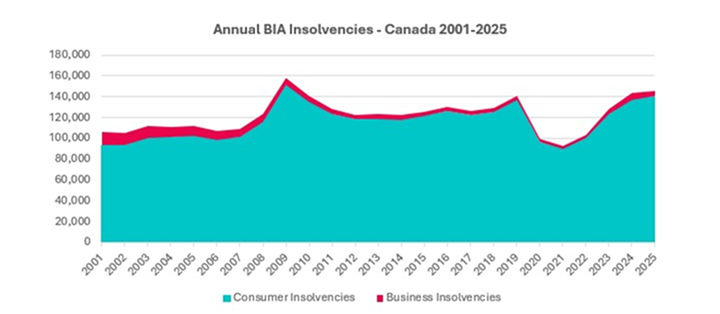
If you want to understand why affordability remains Canada's biggest economic challenge, look beyond inflation and interest rates. The latest insolvency data shows more households are still reaching a financial breaking point, even as the broader economy stabilizes.
Key takeaways:
Total insolvencies fell 3.7% from April to May, but remain 4.6% higher over the past 12 months. The short-term trend is easing, but financial stress remains elevated relative to last year.
The increase continues to be driven primarily by consumer insolvencies, which rose 5.2% over the past 12 months, compared with a 10.9% decline in business insolvencies.
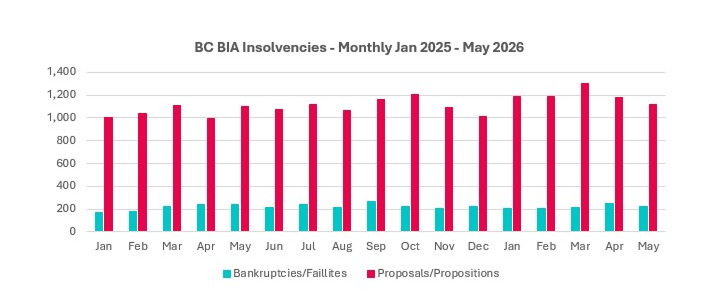
Consumer proposals remain elevated compared to consumer bankruptcies suggesting that households are still managing pressure through restructuring debt.
Business insolvencies remain below last year's levels, but pressure is concentrated in a handful of sectors.
Looking beyond the monthly fluctuations, the broader trend is one of continued household strain rather than a broad-based deterioration in business conditions.
Over the 12 months ending May 2026, Canada recorded 149,134 insolvencies, up 4.6% from the previous 12-month period. Almost all of that increase came from consumers.
Consumer insolvencies rose by 7,115 filings, while business insolvencies fell by 575 filings.
This distinction matters. During the immediate post pandemic period, rising insolvencies were often linked to the unwinding of emergency supports and deferred obligations. That effect has largely worked through the system
Today's numbers look more consistent with households adjusting to a prolonged period of elevated living costs, high housing expenses, and slower income growth.
At the industry level, the biggest increases in insolvencies from April to May were concentrated in in construction (67 filings), accommodation and food services (56), retail trade (45), transportation and warehousing (44), and manufacturing (42). Together, these sectors accounted for more than half of all classified business insolvencies in May.
Broadly, construction , accommodation and food service, and retail trade sectors continue to account for the largest share of business insolvencies in Canada, with 759 and 648 filings respectively over the past 12 months. The more notable story is where insolvencies are growing:
Management of companies and enterprises (+21.2%) and mining, quarrying and oil and gas extraction (+21.4%) recorded some of the largest increases, highlighting pockets of persistent financial pressure despite the broader decline in business insolvencies.
In British Columbia, total insolvencies fell 5.8% between April and May, providing some short-term relief. The longer-term picture tells a different story.
The May insolvency data does not point to a crisis. It points to a prolonged squeeze. This suggests affordability pressures are becoming more structural and more difficult for many households to absorb.
Vancity is a values-based financial co-operative serving the needs of its 588,000 member-owners and their communities, with offices and more than 60 branches located in Metro Vancouver and Squamish, the Fraser Valley, the Sunshine Coast, the Vancouver and Gulf Islands and Alert Bay, within the territories of the Coast Salish and Kwakwaka'wakw Peoples. With $41 billion in assets plus assets under administration, Vancity is Canada's largest credit union. Vancity uses its assets to help improve the financial well-being of its members while at the same time helping to develop healthy communities that are socially, economically, and environmentally sustainable.
