
September 9, 2026
Vancouver, B.C.
The labour market is holding, but it is not hiring broadly.
Statistics Canada's September 4 Labour Force Survey release suggests that August interrupted the labour market's momentum, but it did not erase it. Canada still has more people working today than it did at the start of the year. The question is why employment growth has slowed so dramatically despite stable interest rates and a still-growing economy. In BC, employment barely changed over the first eight months of 2026, and growth is concentrated in a narrow group of industries.
Key takeaways
Canada lost 42,000 jobs in August, after adding a cumulative 181,000 from April to July. The unemployment rate held at 6.4%, but the employment rate slipped to 60.8%.
The core story is that job growth is becoming increasingly concentrated in a handful of sectors while the labour market becomes harder to enter. Nearly one in four unemployed Canadians has been searching for work for more than six months. As a result, the gap is widening between people who already have work and those trying to find it.
BC’s labour market looks stable at first glance, but the stability is masking a deeper shift in where opportunity is being created. Health care, manufacturing and transportation continue to expand, while retail, finance and business support services contract.
The August labour market report suggests that the challenge is increasingly access to opportunity.
While employment declined in August, the unemployment rate remained stable at 6.4%. This suggests a labour market that is holding up reasonably well. However, there are growing signs that finding work is becoming more difficult. Nearly one in four unemployed Canadians had been searching for work for at least 27 weeks, while youth employment declined and youth unemployment remained elevated.
For people who already have jobs, conditions remain relatively stable. For those trying to enter the labour market, re-enter after a job loss, or secure their first opportunity, the path is becoming more challenging.
Put differently, the labour market appears to be doing a better job of retaining workers than creating new opportunities.
July raised questions about the composition of employment growth, particularly the role of self-employment in supporting job gains. August shifts the focus to whether enough new opportunities are being created at all.
Employment remains higher than it was at the start of the year, but growth has slowed considerably and a growing share of unemployed Canadians are spending longer periods searching for work. At the same time, job growth is becoming increasingly concentrated in a smaller number of industries rather than being broadly shared across the economy.
BC lost 5,500 jobs in August, a relatively small decline after adding 50,800 over the previous three months. The provincial unemployment rate nevertheless rose to 6.5%.
The more important story is not the August decline. It is how little net progress the province has made since the start of the year. Total employment was 2.949 million in August, only 1,600 above January.
In as much as the labour market appears stable, beneath that stability, however, employment is being reallocated across industries rather than expanding broadly.
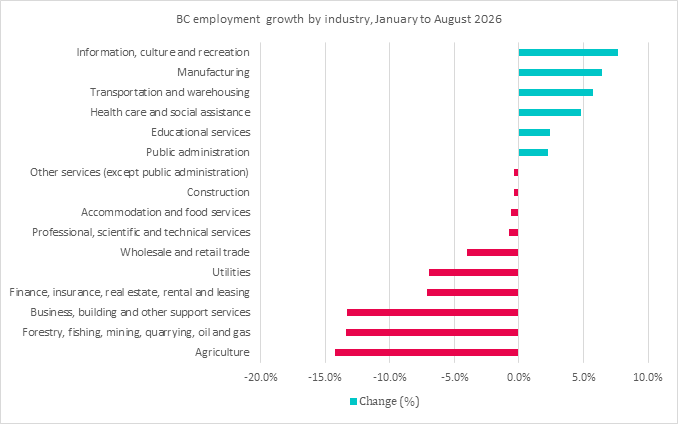
Since January, health care and social assistance added 20,600 jobs. Manufacturing added 11,500, information, culture and recreation added 10,100, and transportation and warehousing added 8,700. Together, these industries account for more than 50,000 new jobs.
Over the same period, wholesale and retail trade lost 17,100 jobs, finance, insurance and real estate lost 13,500 jobs, business, building and other support services lost 13,100 jobs, and natural resources lost 5,500 jobs.
This suggests a labour market that is shifting away from consumer-facing and housing-related activity toward sectors tied to essential services, goods production and logistics.
Health care reflects growing demographic demand. Transportation supports the movement of goods through supply chains. Manufacturing has benefited from a renewed focus on domestic production and industrial investment. Meanwhile, weaker hiring in retail, finance and business support points to softer consumer demand, a slower housing market and continued business caution.
BC is not simply gaining or losing jobs. It is changing where opportunity exists.
For households, the challenge is not only whether jobs are available. It is whether available jobs match people's skills, experience and location.
A worker leaving retail, business services or real estate cannot necessarily move directly into health care, manufacturing or transportation. As employment shifts between sectors, some workers will find new opportunities quickly while others face longer job searches.
At the same time, wage growth slowed nationally to 2.0% in August, down from 2.8% in July. Combined with rising long-term unemployment, this suggests that some households may continue to feel financial pressure even if the overall labour market appears relatively stable.
The unemployment rate tells us how many people are looking for work. It does not tell us how long the search is taking or how difficult it is to transition into the sectors that are growing.
The August survey provides only an early look at how trade uncertainty may affect the labour market.
So far, manufacturing has remained a bright spot both nationally and in BC. However, many of the industries most exposed to US demand have not yet experienced the full impact of recently announced tariffs.
The risk is not necessarily a sudden wave of layoffs. A more likely outcome is that businesses delay hiring, postpone expansion plans or reduce investment while waiting for greater clarity on future trade conditions.
If that occurs, the next phase of labour market weakness may show up through slower hiring rather than large job losses.
Employment remains higher than it was at the start of the year, but the labour market is becoming less accessible.
The challenge for Canada is no longer simply creating jobs. It is creating enough opportunities, in enough sectors, for people looking to participate in growth. In BC, where employment has been largely flat, that challenge is becoming increasingly visible.
The views and opinions expressed in this publication are solely and independently those of the author and do not necessarily reflect the views and opinions of any organization or person affiliated with the author. While reasonable effort was taken to ensure the information and analysis are accurate, this publication has been prepared for general information purposes only. Nothing in this publication should be construed as professional advice. The author does not assume liability arising from reliance on this publication.
Vancity is a values-based financial co-operative serving the needs of its 588,000 member-owners and their communities, with offices and more than 60 branches located in Metro Vancouver and Squamish, the Fraser Valley, the Sunshine Coast, the Vancouver and Gulf Islands and Alert Bay, within the territories of the Coast Salish and Kwakwaka'wakw Peoples. With $42.4 billion in assets plus assets under administration, Vancity is Canada's largest credit union. Vancity uses its assets to help improve the financial well-being of its members while at the same time helping to develop healthy communities that are socially, economically, and environmentally sustainable.
