
November 2, 2026
Vancouver, B.C.
Canada still has more than half a million job vacancies. So why does the labour market feel softer?
Payroll employment fell by 49,600 positions, or 0.3 per cent, in August, following a revised decline of 15,700 in July. This means Canada lost roughly 65,300 payroll positions over the two months. The decline was also relatively broad, with payroll employment falling in 10 of 20 sectors in August, including construction, retail and accommodation and food services.
The provincial picture adds another layer.
In B.C., payroll employment fell by about 6,300 in August, following a decline of about 2,500 in July. By August, B.C. had roughly 3,800 fewer payroll employees than in January. Ontario also recorded a sizeable August decline of about 43,700, Alberta declined by about 4,600, while Quebec moved in the opposite direction, adding about 10,500 payroll employees.
While we are seeing payroll employment decline, the data show that employers have not stopped looking for workers. Canada had 507,200 job vacancies in August and the vacancy rate remained at 2.8 per cent, unchanged throughout 2026 to date. In B.C., there were 78,400 vacancies, with a vacancy rate of 3.1 per cent, above the national rate but down from 3.3 per cent in February and 3.4 per cent in April.
For small businesses, vacancies remain high, but falling payroll employment suggests employers may be more cautious about turning those vacancies into actual hires.
Meanwhile, for workers already receiving a paycheque, the picture is somewhat better. Average weekly earnings were up 3.7 per cent nationally and 5.2 per cent in B.C. from a year ago. For households, people who remain employed are seeing stronger average paycheques, particularly in B.C., while people looking for work are facing a market in which overall employment growth has become much harder to find.
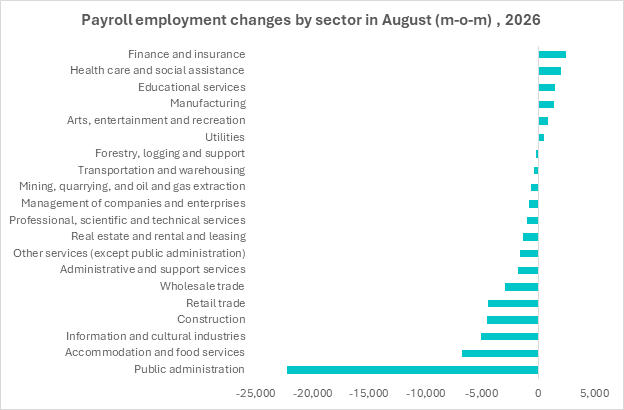
Canada has moved beyond the story of companies simply hiring cautiously. Payroll employment has now weakened for two months, and the weakness extends beyond temporary government staffing. We are not looking at wholesale retrenchment, but we are looking at a labour market entering the fall with fewer sources of momentum.
Vancity is a values-based financial co-operative serving the needs of its 588,000 member-owners and their communities, with offices and more than 60 branches located in Metro Vancouver and Squamish, the Fraser Valley, the Sunshine Coast, the Vancouver and Gulf Islands and Alert Bay, within the territories of the Coast Salish and Kwakwaka'wakw Peoples. With $42.4 billion in assets plus assets under administration, Vancity is Canada's largest credit union. Vancity uses its assets to help improve the financial well-being of its members while at the same time helping to develop healthy communities that are socially, economically, and environmentally sustainable.
